

If you haven’t heard of human powered search engine, Stumpedia, you might want to give it a whirl. It is essentially a human-powered search engine with a social aspect to it. In other words, Stumpedia allows content producers to submit and profit from their work and then allows the search community to determine relevancy of search results. While it is similar to human powered search engines Mahalo and Wikia Search, it differentiates itself because it is powered by the very people that use it.
How Is Stumpedia Different?
Stumpedia takes a different approach to human-powered search than competing sites Mahalo and Wikia Search. For example, the relevancy of search results at Mahalo is determined by their staff whose underlying motive is to profit from their own internally produced and hosted content. Wikia Search takes the wikipedia approach to creating and hosting collaborative content pages.
Where Stumpedia is unique is the fact that it enables registered users to submit sites along with matching keywords and phrases. The relevancy of search results are then ranked and rated by the volunteer community through the ability to vote listings up or down (much like Digg, Mixx and Sphinn). Unlike Mahalo and Wikia Search, Stumpedia is not a content producer or provider and as such does not host any content pages. Furthermore, unlike traditional search engines they do not use bots or crawlers.
How Does It Work?
Anyone can actually jump right on the Stumpedia Home Page and start searching. The real value is being able to add to the search results in case you do not find what you are looking for but are aware of sites that should be included in those results. To be able to add sites, you follow a simple registration process that asks you to provide an email address and your desired user name. Once you verify your email address by clicking on a link in an email they send to you, you are able to contribute to the search engine.
One word of caution – be careful what you add because you will have a unique address that shows what you have added. Therefore if you choose to add spammy sites or other inappropriate sites, it will be viewable via your public profile. While the public profiles keep track of what you have added, they do not record what you have searched for. So, there is some privacy built in to the experience with regards to what you are actually searching for.
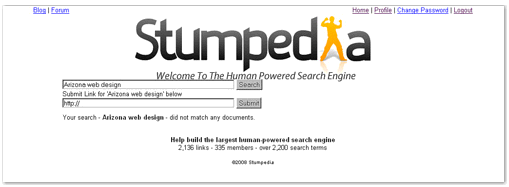
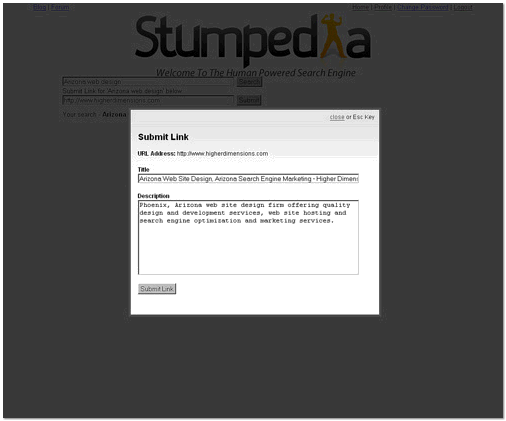
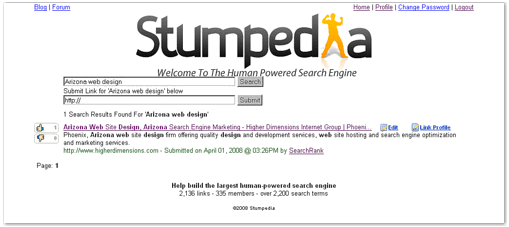
Adding sites is so easy a caveman can do it. For example, I searched for “Arizona web design” which produced zero results (most likely due to the fact that this is still a relatively new service). It’s a good thing I know of a Arizona based web design company (our own) and so I added it. I type in the URL in the submit field and an AJAX function opens a box that reveals a title and description field. If a title tag and meta description tag are present on the site, it populates those fields with that data. However, keep in mind that you can edit those fields as well. After I am satisfied with the data, I hit “Submit Link” and the listing is added as a search result. Sound simple? It is! See screen shots below on how this works.
Initial search for “Arizona web design” produces zero results:
Adding a URL and hitting submit pops up this box:
And finally, the listing shows up as a result:
Additional features include most recent activity being shown on the home page. You can also display submitted search results (listings) by popularity (most votes) in the following time ranges – 24 hours, 7 days, 30 days or 365 days.
What About Spam?
A service such as this is no doubt susceptible to spam. It would be easy enough for spammers to add listings for Viagra for example and then create multiple accounts to vote up their submissions. So, when I asked how Stumpedia planned to deal with such occurrences of spam, they replied with the following statement:
“Presently we’re leaving it up to the community to handle spam submissions by voting down irrelevant results. We’re also monitoring activity and are prepared to take action if spam becomes a problem. Banning people that spam, removing spammy results, etc, are all options we are open to.”
This leads me to wonder if a select number “thumbs down” votes will work to automatically remove spammy results or at the very least, flag those results so that Stumpedia staff can manually remove them or do they simply remain with negative votes. The latter is true for now – Stumpedia staff would have to manually remove them and in the meanwhile they remain although if several listings exist for a particular search query, they will be ranked lower.
Background and Future Plans
Stumpedia officially launched on February 22, 2008 so it is a relatively new service. This is why you will not find search results for many queries. However as time unfolds and as the community continues to contribute, the amount of listings will only grow. As of the writing of this post, there are just 2,160 links submitted and 341 members. So, while they have a long way to go with regards to catching similar services, they have a pretty good model in place.
The service is currently free of any paid advertising. When asked if we will see paid advertising in the future, the answer was yes but the good news is that they will incorporate a revenue sharing model that rewards users that are contributing to the service.
Some future stuff in the works include:
- Users will have the ability to import and share their social bookmarks, making them easily searchable using the Stumpedia search feature. Imported bookmarks would be ranked using their Social Rank algorithm and their associated tags would become search engine friendly. For example, tags such as “search engines,” “search_engines,” “search-engines,” and “searchengines” would be considered one in the same and produce the same search results.
- Social bookmarking features similar to del.icio.us will be added.
- Additional social networking features such as adding/inviting friends and sharing link submissions are in the works.
- They will add a feature that ranks and scores activity of members.
- Future submission sections for news, videos, and images will be added.
Stumpedia sounds like an interesting service, one which I will use and contribute to as time allows. I like the democratic way that users can essentially build this human powered search. My only fear is that once Stumpedia becomes more popular, it will become laden with spam. However, if the community stays active, they should be able to combat that with relative ease.